
Meet the Director
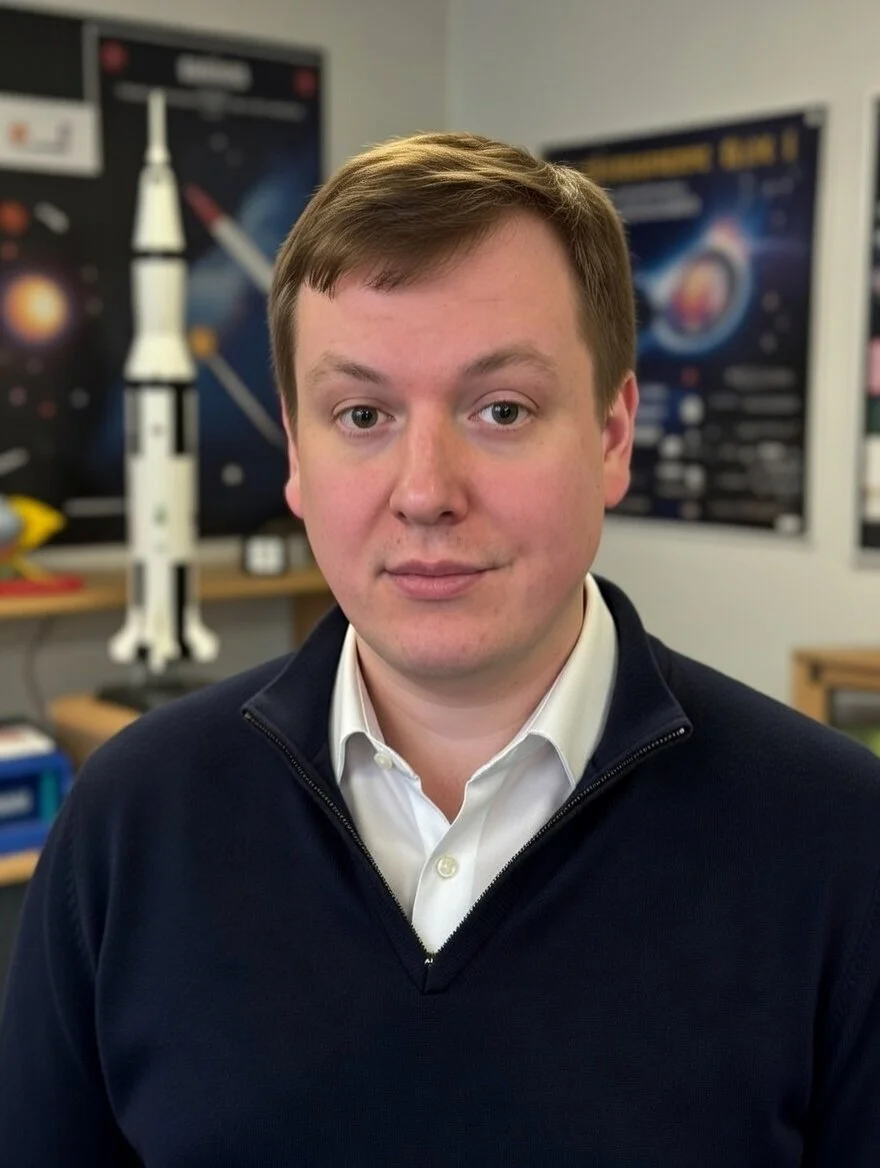
Brian Holder
Director & Lead Instructor
Welcome to Sol Academy Space Agency!
I'm Brian Holder, the creator and primary instructor behind this unique STEM enrichment program.
My goal is simple: to make rigorous math, physics, engineering, and technology feel like an irresistible adventure for homeschool students—by letting them run their own space agencies.
Launching Sol Academy Space Agency in 2026 feels like the culmination of everything I've learned—academically, professionally, and as a homeschool alumnus.
I'm honored to guide your children through their own space agency journeys and can't wait to see the discoveries, leadership, and passion they bring to every mission.
If you're considering Sol Academy Space Agency for your family, I'd love to connect.
Feel free to reach out via the Contact page—I'm happy to answer questions, discuss accommodations, or talk about how this program can complement your homeschool routine.
Together, let's give the next generation the tools, confidence, and wonder to reach for the stars.
-
Brian holds four degrees from Lehigh University: a B.S. in Mathematics, a B.S. in Physics, a B.S. in Business and Economics, and an M.S. in Analytical Finance.
Notably, Brian was the first student in Lehigh University's history to earn three B.S. degrees in the same year.
His professional experience includes several years of tutoring students in math and science, as well as serving as a Teaching Assistant in graduate school, where he guided students through advanced coursework and complex problem-solving.
Homeschooled until college himself, Brian has a deep understanding of the flexibility, family-centered approach, and individualized learning that homeschooling provides.
He also gained practical homeschooling experience while assisting with his nephew's education, an experience that directly inspired the creation of Sol Academy.
-
Brian created Sol Academy Space Agency out of a deep conviction that traditional STEM education often feels abstract and disconnected from real-world purpose, making it difficult for students to see the immediate value in the math, physics, engineering, and technology they are learning.
Drawing inspiration from engaging strategy games such as Leaving Earth, he designed the program to transform these subjects into mission-critical tools within the context of running a mock space agency.
In this immersive environment, every calculation and concept serves a tangible goal: a student who wants to launch a probe to the outer planets must master orbital mechanics, while one planning a self-sustaining Mars colony needs to calculate resource budgets, design life-support systems, and engineer practical solutions.
By embedding rigorous academics within high-stakes, gamified missions, Brian fosters intrinsic motivation—students eagerly tackle the material because it directly advances their agency’s objectives.
The structure also emphasizes leadership development, as older students take on real mentoring roles within the family-style cohorts, guiding younger crew members and building essential collaboration skills.
Through this purposeful, adventure-driven approach, Brian aims to ignite lasting confidence, curiosity, and passion for STEM in homeschool students, giving them the tools and excitement to reach for the stars.